
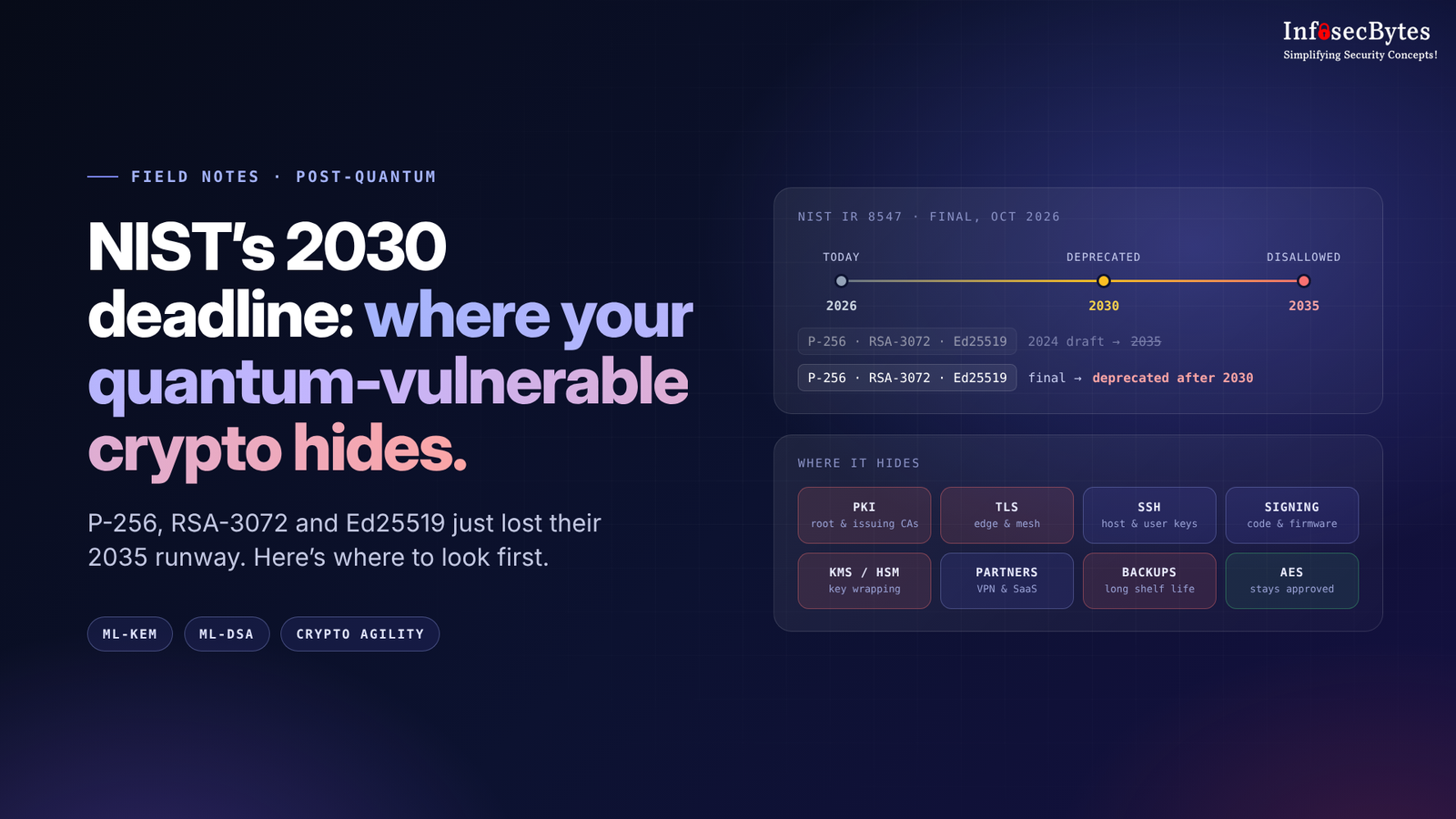
A lot of post-quantum roadmaps quietly relied on one line in a 2024 draft. On 27 October 2026, NIST deleted it. If your plan assumed P-256, RSA-3072 or Ed25519 could run untouched until 2035, that plan just lost five years.
The final version of NIST IR 8547, Transition to Post-Quantum Cryptography Standards, keeps the two headline dates everyone already knew: quantum-vulnerable public-key cryptography is deprecated after 2030 and disallowed after 2035. What changed is who those dates apply to. The November 2024 draft ran a two-speed model: 112-bit parameters like RSA-2048 were deprecated after 2030, but 128-bit-and-above choices such as P-256, P-384, RSA-3072 and Ed25519 skipped deprecation entirely and ran straight to 2035.
That second lane is gone. The final report deprecates all quantum-vulnerable signature algorithms after 2030, and all classical key establishment with them. For most enterprises, P-256 is the most widely deployed key on the network. It sits in service-mesh certificates, container signing, cloud load balancers and half the TLS endpoints on the internet. It now has the same 2030 date as RSA-2048.
// What actually changed
One table, five years.
| Algorithm | Where you’ll find it | 2024 draft | Final (Oct 2026) | Replacement |
|---|---|---|---|---|
| RSA-2048 | Legacy PKI, VPNs, older TLS, code signing | Deprecated after 2030 | Deprecated after 2030 (unchanged) | ML-KEM / ML-DSA |
| RSA-3072 / 4096 | “Upgraded” CA hierarchies, HSM-backed keys | Straight to 2035 | Deprecated after 2030 | ML-DSA, SLH-DSA |
| ECDSA P-256 / P-384 | Service mesh, TLS, container and artefact signing | Straight to 2035 | Deprecated after 2030 | ML-DSA |
| Ed25519 | SSH keys, modern signing tools | Straight to 2035 | Deprecated after 2030 | ML-DSA |
| ECDH / DH / RSA key exchange | Every TLS, SSH and IPsec handshake | Split by strength | Deprecated after 2030 at all strengths | ML-KEM (hybrid first) |
| AES-128/256, SHA-2, SHA-3 | Data at rest, session encryption, hashing | Approved | Approved; no PQC transition expected | — |
All quantum-vulnerable algorithms are disallowed after 2035. ML-KEM is FIPS 203, with ML-KEM-768 as the default parameter set; ML-DSA is FIPS 204 and SLH-DSA is FIPS 205. FN-DSA (FIPS 206) and HQC, a backup KEM, are still being standardised.
A platform team I advised finished a two-year migration from RSA-2048 to ECDSA P-256 last year. The business case explicitly cited the draft’s 2035 runway: modern curve, smaller keys, “and it buys us until 2035 for PQC.” It was a good engineering decision, and the faster handshakes were real.
The runway half of that business case is gone. Nothing they built is wasted, because the automation that rotated RSA into ECDSA is exactly what will rotate ECDSA into ML-DSA. But anyone who budgeted on that 2035 runway needs to know before the next planning cycle, not after it.
// Deprecated is a governance word
“Deprecated” doesn’t mean forbidden. It means someone signs for it.
In NIST’s vocabulary, a deprecated algorithm can still be used, but the data owner has to assess the security risk and decide whether to accept it. Read that from a risk team’s point of view. From 1 January 2031, every remaining use of RSA or elliptic-curve cryptography in a NIST-aligned environment becomes a documented risk acceptance, with an owner and a rationale.
For a bank with tens of thousands of certificates, that is not a cryptography problem. It is a risk register problem. You will need to know where every instance is, what it protects and who owns the decision to keep it. That is the same inventory you need to migrate in the first place, so build it once.
Deprecated doesn’t mean forbidden. It means every remaining use becomes a risk decision someone has to sign.
Regulated firms will feel this before 2030 through their suppliers. In the US, Executive Order 14412 and OMB memo M-26-15 require federal high-value assets and high-impact systems to use post-quantum key establishment by 31 December 2030 and post-quantum signatures by 31 December 2031, and CISA is due to publish minimum elements for a cryptographic bill of materials (CBOM) in 2027. None of that binds a private bank directly. All of it shapes what your vendors build, what FIPS-validated modules support, and the questions supervisors will start asking.
// Two different clocks
Confidentiality is urgent now. Trust has a longer fuse.
Teams lump all of PQC into one bucket, then can’t decide where to start. There are really two separate problems, running on two different clocks.
An attacker who records your encrypted traffic today can decrypt it once a capable quantum computer exists. The AES that encrypts the session is fine; the ECDH or RSA handshake that delivered the AES key is the weak point. Any data that must stay confidential beyond the arrival of such a machine is already exposed if it crosses a network you don’t control. For banks, that means client records, trade data, M&A material and anything with a ten-year retention rule.
A quantum computer can’t retroactively forge yesterday’s authentication; signatures only matter while they’re being verified. That sounds like more time, until you look at how long trust anchors live. A root CA issued today with a 20-year validity runs to 2046. Firmware signing keys burned into hardware can’t be rotated at all. Long-lived trust has to be re-planned now, even if the forgery risk is years away.
Mosca’s inequality is the cleanest way to explain it to anyone. If how long the data must stay secret plus how long your migration takes is greater than the time until a cryptographically relevant quantum computer, you are already late. You don’t control the third number. You do control the second one.
// Where it’s hiding
Seven places quantum-vulnerable crypto lives in a real estate.
Nobody’s first inventory is complete. These are the places I look first, roughly in the order they surprise people.
Two-tier ADCS hierarchies, offline roots with 20-year validity, issuing CAs, OCSP responders and CRL signing, smart-card logon and certificate-based VPN authentication. A root you stand up this year should already have a post-quantum succession plan. The awkward question is not “which algorithm” but “how many relying parties have this root pinned, and how do we tell them it’s changing?”
Load balancers, ingress controllers, API gateways, CDN and WAF edges, and service-mesh mTLS, where workload certificates are typically ECDSA P-256 and rotate automatically. The good news: hybrid key exchange (X25519MLKEM768) is already the default in major browsers and supported in OpenSSL 3.5 and large CDNs. The edge is often the cheapest place to make your first measurable progress.
Recent OpenSSH releases already default to a hybrid ML-KEM key exchange, which closes the harvest-now risk for sessions between up-to-date endpoints. Host and user keys are still RSA, ECDSA or Ed25519, and there is no widely deployed post-quantum SSH signature yet. Every SSH key inventory I’ve run has turned up keys nobody could explain. Those are the ones that will still be there in 2031.
Release signing keys, container image signatures and attestations, package repositories and firmware roots of trust. Signed artefacts can be verified for years after they’re produced, and firmware roots fixed in hardware can’t be changed without replacing the hardware. That makes this a procurement question as much as an engineering one.
Envelope encryption is AES all the way down, which is fine. The vulnerable part is the wrapping: RSA-OAEP used for BYOK key import and export, key transport between HSMs, and backup keys wrapped to an RSA public key. HSM refresh cycles run five to seven years, so the hardware you buy next year needs a post-quantum firmware roadmap in the contract.
Site-to-site IPsec with partners, payment and messaging networks, file-transfer gateways, and every SaaS provider holding long-lived data. You can’t migrate their crypto; you can make their roadmap a third-party risk question. This is usually the slowest part of the estate to move, which is why it needs to be first on the list of questions.
Encrypted backups whose data keys are wrapped with RSA, long-term archives, and digitally signed records that must still verify in ten years. These are the textbook harvest-now targets: high value, long-lived, and often copied off-site to places with weaker monitoring.
AES isn’t your problem. The handshake that delivered the AES key is.
It is also worth saying what is not on the list. Kerberos in Active Directory is mostly symmetric AES and doesn’t need a post-quantum migration, although PKINIT certificate logon and LDAPS do. Disk and database encryption at rest is AES, as are most session ciphers. A credible PQC programme is as clear about what it is leaving alone as about what it is changing. Ripping out AES-256 is a sign someone hasn’t read the guidance.
// Finding it for real
Start with what you can query today.
A full cryptographic bill of materials comes later. You can get a useful first picture in a week from things you already run: certificate stores, SSH configs, TLS endpoints and source code.
# 1. Windows trust stores: which roots and CAs are RSA/ECC and live past 2030?
Get-ChildItem Cert:\LocalMachine\Root, Cert:\LocalMachine\CA |
  Where-Object { $_.NotAfter -gt '2030-12-31' } |
  Select-Object Subject, NotAfter, @{n='Alg';e={$_.PublicKey.Oid.FriendlyName}}

# 2. Any PEM certificate: key type, size and expiry.
openssl x509 -in cert.pem -noout -text | grep -E 'Public Key Algorithm|Public-Key|Not After'

# 3. SSH: host key types, and whether this client can do hybrid ML-KEM.
for k in /etc/ssh/ssh_host_*_key.pub; do ssh-keygen -lf "$k"; done
ssh -Q kex | grep -i mlkem

# 4. Source code: hard-coded algorithm choices are your crypto-agility debt.
git grep -nEi 'secp256r1|prime256v1|P-256|RSA_PKCS1|rsa.GenerateKey|ed25519|ECDH'
The fourth query matters more than it looks. Certificates can be reissued by a pipeline. Algorithms hard-coded in application code have to be found, changed, tested and released one by one. That count is the most honest measure of your crypto agility you will get.
| Asset | Quantum-vulnerable part | Urgency | First move |
|---|---|---|---|
| External TLS edge | ECDH key exchange | NOW | Enable hybrid X25519MLKEM768; measure handshake size and breakage |
| Long-retention data over external links | Key exchange (harvest now) | NOW | Identify flows and owners; prioritise hybrid on those paths |
| Backups and archives | RSA-wrapped data keys | NOW | Re-wrap plan; confirm KMS/HSM PQC roadmap |
| Root and issuing CAs | RSA/ECDSA signatures; long validity | BY 2030 | No new roots valid past 2035 without a succession plan |
| Code and firmware signing | Signatures on long-lived artefacts | BY 2030 | Inventory signing keys; add PQC to hardware procurement |
| Service mesh and internal mTLS | ECDSA P-256 certs, ECDH | BY 2030 | Confirm mesh and CA support; rotation is already automated |
| SSH estate | Host/user key signatures | BY 2035 | Inventory and remove unused keys now; upgrade OpenSSH for hybrid KEX |
| Partner links and SaaS | Whatever they run | BY 2030 | Add PQC questions to third-party risk reviews |
// How I’d sequence it
The first 90 days, without boiling the ocean.
Days 0–30 — inventory and owners. Run the queries above across certificate stores, TLS endpoints, SSH, code repositories, KMS and HSM configurations. Put every finding on one register with a named owner. Don’t try to make it complete; make it owned. Kill anything nobody claims.
Days 30–60 — rank by shelf life, not by count. Classify data by how long it must stay confidential, then map which network flows carry the long-lived data. Those flows, plus your long-lived trust anchors, are the priority list. In parallel, add five PQC questions to vendor and third-party risk reviews: algorithm roadmap, hybrid support, FIPS-validated module timeline, crypto agility, and CBOM availability.
Days 60–90 — one real pilot and one real standard. Turn on hybrid key exchange at one external edge and measure it properly: handshake size, latency, and which middleboxes or old clients break on the larger ClientHello. Then publish a short cryptography standard: no new root or code-signing key valid beyond 2035 without a post-quantum succession plan, no hard-coded algorithms in new code, and crypto agility as an architecture review question.
// Mistakes I keep seeing
Where PQC programmes stall.
HSMs, load balancers and network appliances bought in 2027 will still be in service in 2033. If PQC support isn’t in the contract now, the refresh you’re waiting for won’t include it.
The crypto team can choose algorithms. It can’t find every hard-coded curve in application code, renegotiate partner VPNs or own the risk acceptance for a legacy system. PQC is an inventory, engineering and third-party risk programme with a cryptography workstream inside it.
Post-quantum keys and signatures are bigger: an ML-KEM-768 public key is 1,184 bytes against 32 for X25519, and an ML-DSA-65 signature is about 3.3 KB against 64 bytes for Ed25519. That breaks things with tight size limits, from older middleboxes to certificate chains in constrained devices. Pilot before you mandate.
There won’t be one. ML-KEM arrives at the edge first, ML-DSA in PKI later, and FN-DSA and HQC are still being finalised. The goal isn’t to switch algorithms once; it’s to make switching routine. Crypto agility is the real deliverable.
// Crypto agility as a control
Make agility something you can test, not something you claim.
“We are crypto-agile” is a claim every architecture document makes and almost nobody tests. Turn it into a control with evidence. Pick a representative service each quarter and change its certificate algorithm, or its key-exchange group, through the normal pipeline. Measure how long it takes and what breaks. If the answer is days and nothing breaks, the control works. If the answer is a project plan, you have found your real migration timeline, and it is better to find it in a test than in 2030.
// Taking it upstairs
Explaining it to the board in three sentences.
What changed. “NIST has confirmed that the public-key cryptography protecting most of our systems, including the newer algorithms we assumed had until 2035, is deprecated after 2030.”
Why it matters now. “Encrypted data with a long shelf life can be captured today and decrypted later, and our suppliers and supervisors will expect a credible plan well before 2030.”
What we need. “We’re asking for a funded inventory and an edge pilot this year, and for post-quantum support to become a standard requirement in hardware and vendor contracts from now on.”
No qubit counts, no predictions about when the machine arrives. The board doesn’t need to believe a date. It only needs to see that the migration takes longer than the data needs to stay secret.
// The throughline
The deadline moved. The work didn’t change.
The final IR 8547 didn’t invent new work. It removed an excuse. Inventory, ownership, shelf-life ranking, vendor pressure and crypto agility were always the job. What has changed is that P-256 and Ed25519 can no longer sit in the “later” pile.
The teams that will be fine in 2031 are not the ones with the best cryptographers. They’re the ones who can say, for any key on the network, where it is, what it protects, who owns it and how fast they can change it. Start with that list. The algorithms are the easy part.
- ✓Inventoried — certificates, TLS endpoints, SSH keys, signing keys, KMS/HSM wrapping and hard-coded algorithms on one register
- ✓Owned — every entry has a named owner who can make the 2031 risk-acceptance call
- ✓Ranked — priorities set by data shelf life and trust-anchor lifetime, not by system count
- ✓Piloted — hybrid ML-KEM running at one edge, with handshake size, latency and breakage measured
- ✓Standardised — no new roots or signing keys valid past 2035 without a post-quantum succession plan
- ✓Contracted — PQC roadmap, hybrid support and FIPS timelines required in hardware and vendor agreements
- ✓Agile — algorithm changes tested through the normal pipeline every quarter, with time-to-change measured
- ✓Scoped — AES, SHA-2 and Kerberos AES explicitly out of scope, so effort goes where the risk is
Written by a principal security architect with roughly 18 years across fintech, SaaS and consulting, including designing enterprise PKI and machine identity at scale. Views are the author’s own and don’t constitute legal, regulatory or financial advice. Client scenarios are composites, anonymised and lightly fictionalised to make a real pattern clear; any resemblance to a specific organisation is coincidental. Dates and algorithm statuses reflect the final NIST IR 8547 (October 2026) and US federal guidance as of November 2026; check the source documents before relying on them. Commands are starting points for your own testing, and output formats vary by version.
Still planning on a 2035 runway?
Send this to whoever owns your PKI.
The inventory you need to migrate is the same one you’ll need to sign the risk acceptances. Build it once, and start now.