
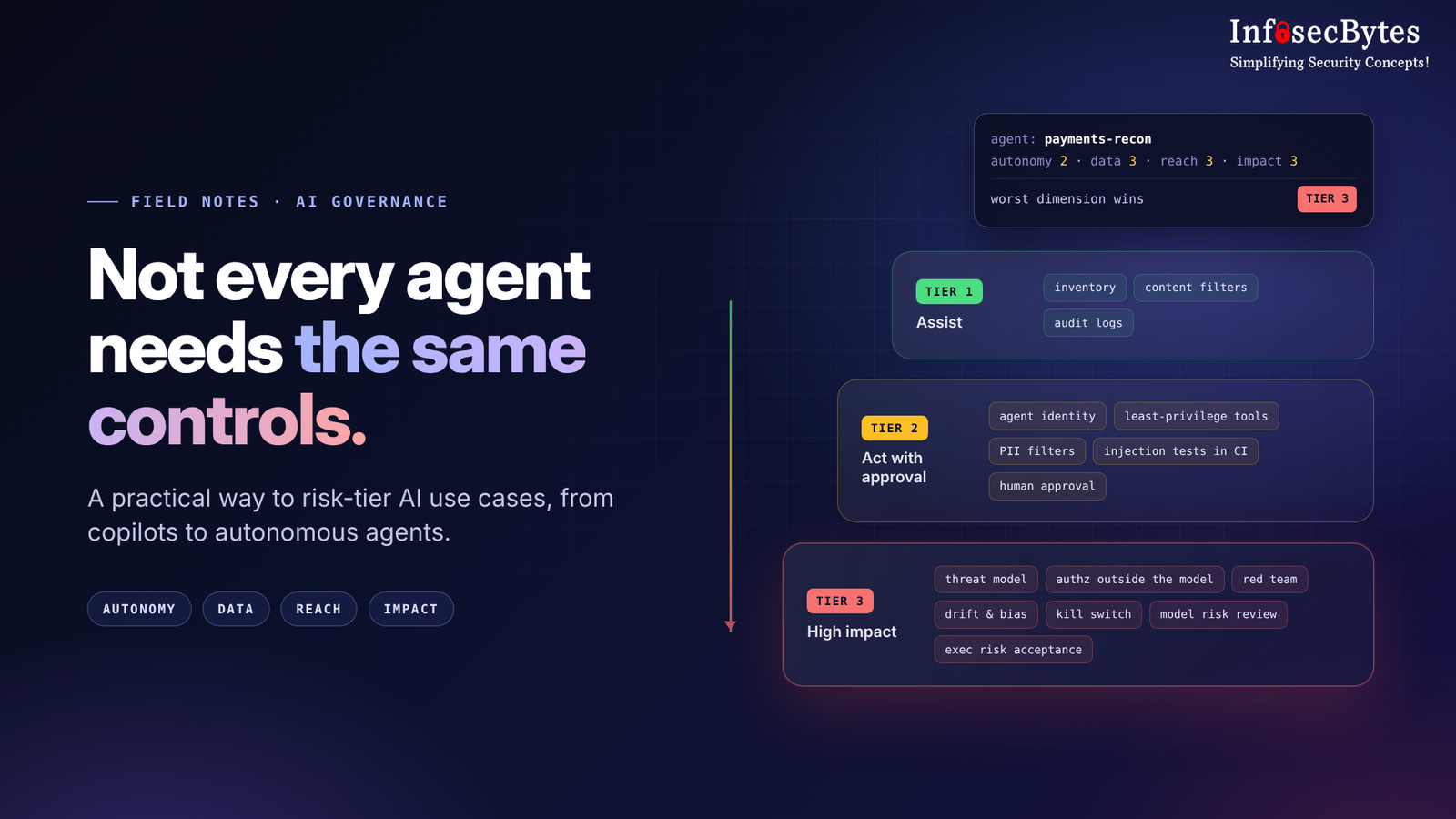
Most AI governance programmes I review fail in one of two directions. Either every chatbot gets dragged through the same forty-page review as a credit model, or the review is so light that the agent wired into the payments system sails through like an FAQ bot. Both come from the same root cause: no honest way to say how much control a given use case actually needs.
Europe just handed a lot of teams an excuse to keep putting that question off. The Digital Omnibus pushed the EU AI Act’s high-risk obligations back to 2 December 2027 for stand-alone systems and 2 August 2028 for AI embedded in regulated products. I’ve heard “we have another year” in three different rooms since the summer.
The regulation moved. The agents didn’t. They are being built this quarter in Copilot Studio, Microsoft Foundry and Amazon Bedrock, by teams who can add a connector to a production system in about two minutes. The risk exists now, whether or not a regulator is looking at it yet. What follows is the tiering model I actually use: four dimensions, three tiers, a minimum control set per tier, and a way to explain the result to an executive in three sentences.
// Why one-size-fits-all breaks
Uniform governance is either theatre or a bottleneck.
When every AI use case gets the same review, two things happen. The heavy review becomes a queue, teams learn that “it’s just a pilot” skips the queue, and shadow agents multiply. Or the review gets thinned out to keep the queue moving, and now the genuinely dangerous systems get the same light touch as the harmless ones.
Proportionality is not a soft option. It is the only way the high-risk reviews get the attention they deserve. NIST’s AI RMF builds the whole Map function around context, ISO/IEC 42001 asks you to assess impact per AI system, and the EU AI Act itself is a tiered regime. Tiering is not a shortcut around those frameworks. It is how they expect to be applied.
// What actually drives the risk
Four dimensions. Not the model, not the vendor.
The first instinct is to tier by model: frontier model, high risk; small open-weight model, low risk. In practice the model is rarely what decides the blast radius. What it is wired to does. These are the four things I score, each from 1 to 3.
| Dimension | 1 · Low | 2 · Medium | 3 · High |
|---|---|---|---|
| Autonomy who decides |
Suggests or drafts; a human does everything | Acts, but a human approves each action | Acts on its own, chains steps without approval |
| Data what it can see |
Public or general internal content | Confidential business data | Customer PII, employee records, regulated or market-sensitive data |
| Reach what it can touch |
Read-only; answers questions | Writes to internal systems (tickets, records, config) | Customer-facing, external, financial or hard-to-reverse actions |
| Impact who is affected if wrong |
Internal convenience; easy to spot and correct | Decisions about individual employees or customers | Many customers, money movement, regulatory or market exposure |
Two rules turn the scores into a tier, and both are deliberate.
Averaging is how a dangerous dimension hides. An agent that scores 1, 1, 1 and 3 averages to “low”, and that single 3 is usually the thing that ends up in the incident report. The tier is the worst dimension.
An agent that can see everything but only suggests is manageable. An agent that can act but only on low-stakes systems is manageable. An agent that can act and has reach is where nearly every agentic incident I’ve looked at comes from. If both are 2 or higher, add one tier, capped at 3.
On top of that sits one hard override: anything that falls into an EU AI Act Annex III category, such as creditworthiness assessment or screening job candidates, goes straight to Tier 3 regardless of score. For a bank, that override catches more use cases than people expect.
Here is what it looks like as code. Putting it in the intake pipeline instead of a spreadsheet means the tier is recalculated every time someone changes the inputs, not once at kick-off.
# ai-intake/hr-leave-assistant.yaml
use_case: hr-leave-assistant
platform: copilot-studio
owner:    people-platform          # a team, never a person who might leave
scores:
  autonomy: 2   # submits leave requests after user confirms
  data:     3   # employee personal data from the HRIS
  reach:    2   # writes to the HRIS
  impact:   2   # affects individual employees
regulatory_flags: []
# tiering.py
def risk_tier(s: dict, flags: list[str]) -> int:
    tier = max(s.values())                      # rule 1: worst dimension wins
    if s["autonomy"] >= 2 and s["reach"] >= 2:
        tier = min(tier + 1, 3)                 # rule 2: acting + reach
    if "eu_ai_act_annex_iii" in flags:
        tier = 3                                # hard override
    return tier
// What each tier must have
Three tiers, each with a floor, not a wish list.
Each tier gets a minimum control set. Teams can always do more. They can’t do less without a documented risk acceptance from someone senior enough to own the consequence. Each tier includes everything in the tier below it.
| Control area | TIER 1 Assist | TIER 2 Act with approval | TIER 3 High impact |
|---|---|---|---|
| Inventory & ownership | Registered in the AI inventory with an owning team | + Data-flow diagram, AI-BOM (model, embeddings, tools, data sources) | + Threat model and a named business risk owner |
| Identity & access | Runs as the signed-in user; no anonymous access | + Dedicated agent identity; tools scoped to least privilege | + No standing write access; authorisation checked per action outside the model |
| Guardrails | Platform content filters and prompt-attack detection on | + PII filtering, grounding checks, hardened system prompt | + Allow-listed tools only; action parameters validated server-side |
| Testing | Baseline prompt-injection suite before release | + Injection and jailbreak regression in CI on every change | + Independent red team before go-live and after material change |
| Human oversight | User told they’re talking to AI | + Human approves every write action | + Approver sees the evidence behind the action; tested kill switch |
| Logging & monitoring | Platform audit logs retained | + Prompts, tool calls and retrieved sources logged | + Drift and bias evaluation, anomaly alerting, retention set for record-keeping |
| Data | Approved sources only | + Permission-aware retrieval | + Redaction before embedding; privacy impact assessment |
| Sign-off | Team self-attests, with spot checks | Security architecture review | Risk acceptance by an accountable executive; reassessed on any model or tool change |
One line in that table matters more than it looks: Tier 1 self-attests, with spot checks. If every Tier 1 use case still needs a security meeting, teams will under-score to avoid it and the model collapses. Let them self-serve, and sample one in five of their attestations. A team that is caught under-scoring loses self-service for a quarter. That works better than any policy memo I’ve written.
// Making it defensible
Map the tiers to the frameworks once, then stop arguing.
An internal tiering model only survives its first audit if every control traces back to something external. I keep the mapping in the standard itself, so nobody has to rebuild it for each review:
| Control area | NIST AI RMF | ISO/IEC 42001 | EU AI Act | Threat reference |
|---|---|---|---|---|
| Inventory & ownership | GOVERN, MAP | Annex A.6 (AI system life cycle) | Art. 9 (risk management) | — |
| Identity & access | MANAGE | Annex A.6, A.9 (use of AI systems) | Art. 15 (cybersecurity) | OWASP LLM06 Excessive Agency |
| Guardrails & testing | MEASURE | Annex A.6 | Art. 15 (accuracy, robustness) | OWASP LLM01; MITRE ATLAS AML.T0051 |
| Human oversight | MANAGE | Annex A.9 | Art. 14 (human oversight) | — |
| Logging & monitoring | MEASURE, MANAGE | Annex A.6 | Art. 12 (record-keeping), Art. 26 (deployers) | — |
| Data | MAP, MEASURE | Annex A.7 (data for AI systems) | Art. 10 (data governance) | OWASP LLM02, LLM08; ATLAS AML.T0020 |
| Impact assessment & sign-off | GOVERN, MAP | Clause 6.1.4, Annex A.5 (assessing impacts) | Art. 27 (FRIA, where applicable) | — |
The EU AI Act column is not only for EU firms. It is the most detailed public statement of what regulators think “adequate control” means for AI, and US and UK supervisors read it too. Mapping to it now costs very little and saves a rewrite later.
// Two worked examples
The tier is a property of the configuration, not the project.
1 · The HR assistant that grew a connector
Version one is a Copilot Studio agent that answers employee questions from the HR policy library in SharePoint. It suggests and never acts, sees internal policy documents and is read-only, and a wrong answer is easy to spot. Scores 1, 2, 1, 1. Tier 2, because confidential internal content sets the floor. Self-serve with a security architecture review, and done in a week.
Six weeks later, someone adds the HRIS connector so the agent can tell people their leave balance. Then, because users asked, it can submit a leave request after the user confirms. Same project, same name, same owner. Now the scores are 2, 3, 2, 2: autonomy and reach are both 2, so add a tier. Tier 3.
This exact drift is the most common pattern I find in Copilot Studio estates. Nobody re-submitted the agent for review, because in their heads it was still “the HR FAQ bot”. The change that moved it from Tier 2 to Tier 3 was a connector added in a maker’s browser tab, not a design decision anyone signed off.
The fix that worked was not a policy. It was making the platform enforce the tier. Tier 1 and 2 agents live in an environment whose Power Platform DLP policy blocks HR, finance and ERP connectors outright, and requires authenticated users. Tier 3 agents can only be published from a separate Managed Environment with its own reviewers. Adding the HRIS connector in the wrong place simply fails, and the failure itself starts the re-tiering conversation.
2 · The ops agent that can resubmit a payment
A Bedrock agent triages failed payment reconciliations. It reads the exception queue, works out the likely cause from retrieved runbooks and transaction history, and has an action group that can resubmit the transaction once an operator approves. Scores 2, 3, 3, 3. Tier 3 before the bump.
The controls that actually matter here are not in the prompt. The action group requires user confirmation before it executes. The Lambda behind it enforces the amount ceiling and the allowed account set server-side, so an injected instruction in a runbook cannot talk it into a larger or different transfer. Bedrock Guardrails’ prompt-attack and PII filters sit in front as defence in depth, but the design assumes they will sometimes miss an indirect injection hidden in retrieved content. Every tool call, the retrieved passages that led to it, and the approver’s identity are logged together, so an investigator can reconstruct why the agent proposed what it did.
Controls that live in the prompt are suggestions. Controls that live in the tool are controls.
// Mistakes I keep seeing
Where tiering programmes quietly go wrong.
A small open-weight model with write access to production is riskier than a frontier model answering policy questions. Score what the system can see and do, not what it runs on. Model choice belongs in the control set (provenance, licensing, evaluation), not in the tier.
Agents grow. Connectors, tools, data sources and autonomy settings change after go-live, often without a new project. Re-tier on any change to those four inputs, and wherever possible let the platform detect the change rather than relying on the team to declare it.
If scoring takes an afternoon, teams will guess, or route around it. Four questions with concrete examples for each score beat an exhaustive questionnaire. The depth belongs in the Tier 3 review, not in the front door.
“Human in the loop” that is a rubber-stamp button with no evidence shown to the approver is not oversight. For Tier 3, test the control: give the approver a deliberately wrong proposal and see whether they catch it.
// Taking it upstairs
Explaining a tier decision in three sentences.
The tier is also a communication tool. Executives don’t need the scoring matrix. They need to know what the system does, what could go wrong, and what you need from them. I use the same three-sentence shape every time:
What it is and what it can touch. “The reconciliation agent can propose and, with operator approval, resubmit failed payments up to a fixed limit.”
What could go wrong and what’s already in place. “The main risk is a manipulated runbook steering it toward a wrong resubmission. Limits are enforced outside the model and every action needs a named approver, so the worst case is a single capped transaction that we would detect the same day.”
The residual risk and the decision. “Residual risk is low to moderate. We’re asking you to accept it for a 90-day pilot, with a re-review before the limit is raised.”
That is a decision an executive can actually make. “The agent is Tier 3 and has 41 controls” is not.
// The throughline
Spend scrutiny where the blast radius is.
The point of tiering is not to produce a number. It is to make sure your best reviewers spend their time on the agent that can move money, not on the one that summarises meeting notes. It also lets the teams building low-risk tools get on with it, without a security meeting standing between them and a useful feature.
The regulatory deadline moving out to December 2027 changes when the formal obligations apply. It doesn’t change what any of these agents can do today. Get the tiering in now, while the estate is still small enough to inventory in a week. In a year, with agents built by every team on three platforms, it will be much harder.
- ✓Scored — every AI use case scored on autonomy, data, reach and impact, taking the worst dimension
- ✓Bumped — acting plus reach adds a tier; Annex III categories go straight to Tier 3
- ✓Floored — each tier has a minimum control set; going below it needs a named executive’s risk acceptance
- ✓Enforced — platform policy (DLP, environments, tool scopes) makes the tier real, not just a document
- ✓Re-tiered — any change to connectors, tools, data sources or autonomy triggers a fresh score
- ✓Outside the model — authorisation and limits for Tier 3 actions enforced in the tool, not the prompt
- ✓Traceable — every control mapped to NIST AI RMF, ISO/IEC 42001 and the EU AI Act
- ✓Explained — tier decisions reported upward as risk, mitigation and a clear ask
Written by a principal security architect with roughly 18 years across fintech, SaaS and consulting, most recently building AI risk frameworks and threat-modelling GenAI and agentic systems in production. Views are the author’s own and don’t constitute legal, regulatory or financial advice. Client scenarios are composites, anonymised and lightly fictionalised to make a real pattern clear; any resemblance to a specific organisation is coincidental. Regulatory dates reflect the EU Digital Omnibus on AI as adopted in 2026. Framework mappings are a practitioner’s interpretation, not legal guidance; platform feature names change, so verify them against current vendor documentation.
Building agents this quarter?
Send this to whoever signs off on them.
The easiest time to tier your AI estate is while it still fits on one page. That page gets longer every sprint.